Should I Read Ac Pressure in My Car When the Compressor Cycles on or Off
AC pressure gauge readings
Diagnose Air-conditioning pressure level gauge readings
How to diagnose auto AC force per unit area guess readings
You can't accurately diagnose your car'south Air-conditioning by using just the low-pressure guess on a recharge kit because you're only seeing pressure on the suction or low side of the entire system. That's non enough information to diagnose a problem. It's like trying to diagnose your overall health with only half of your blood pressure level reading.
Look, I know you want to effigy out your AC problem yourself without buying whatsoever tools, but y'all can really screw up your motorcar's AC if you overcharge or undercharge the system. Overcharging actually REDUCES cooling and undercharging tin can damage the compressor (refrigerant carries the lubricating oil then low refrigerant = oil starvation for the compressor).
So, if you really want to diagnose and set up your Air-conditioning system yourself,
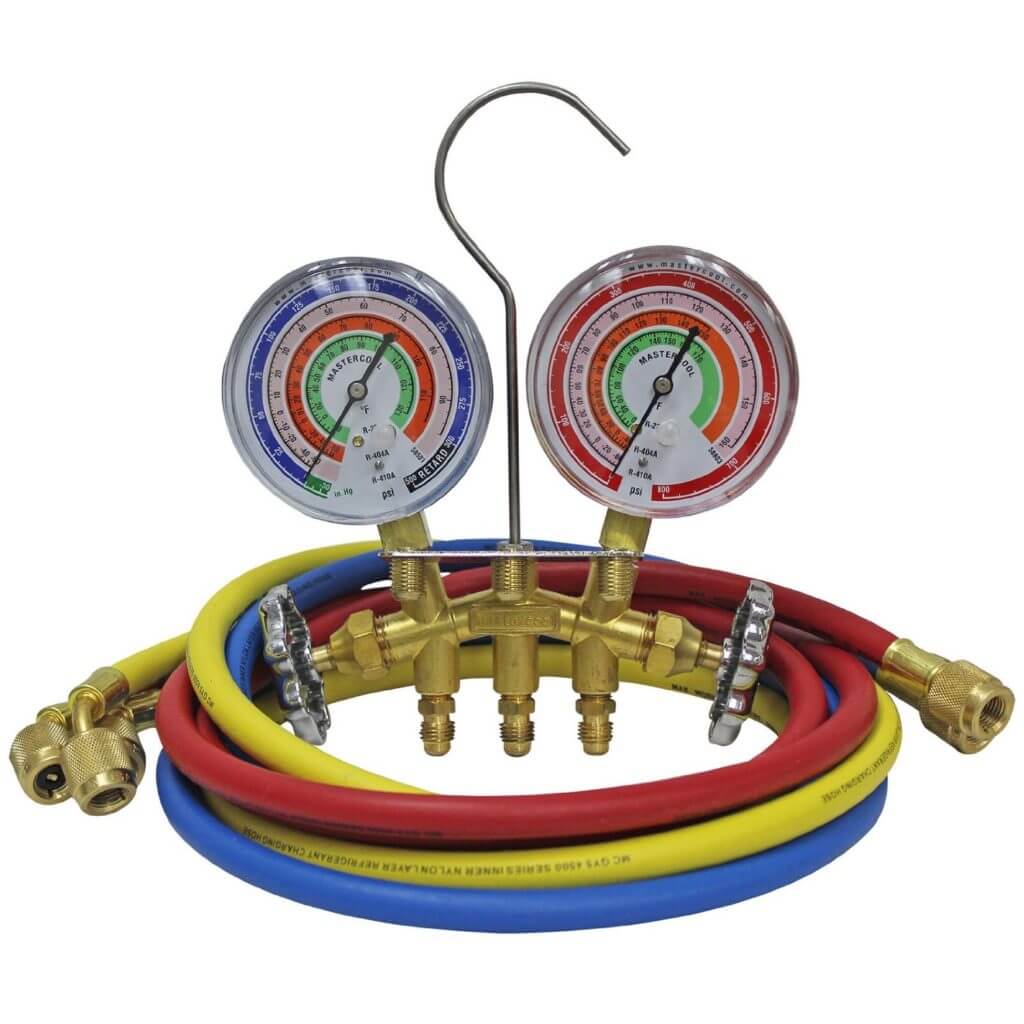
Manifold gauge set with hoses
you'll need an Ac manifold gauge set up and hoses. Buy a set or rent a gear up, simply don't kid yourself into thinking yous can brand any kind of diagnosis without it.
Start your Ac force per unit area readings diagnostic by measuring the organization's STATIC pressure
Static pressure is the pressure with the system at residual (compressor off for at least xxx-mins). Attach to the hoses and gauge fix to the high and low side ports of your AC system.
i. With the engine OFF for at to the lowest degree 30 minutes, read the low and high-pressure level gauges. They should be the same because the loftier and low side pressure equalize once the compressor shuts off. Information technology takes a while to equalize, that'due south why you must expect 30-mins to cheque static pressure
2. Measure ambient air temperature at the vehicle and nether the hood WITH A THERMOMETER (do not utilise atmospheric condition service temperatures). The static pressure correlates to the temperature of the Air conditioning components under the hood, non outside in front of the vehicle.
iii. Compare the pressure readings to the pressure level-temperature chart below
R-134a Static Temperature pressure level chart
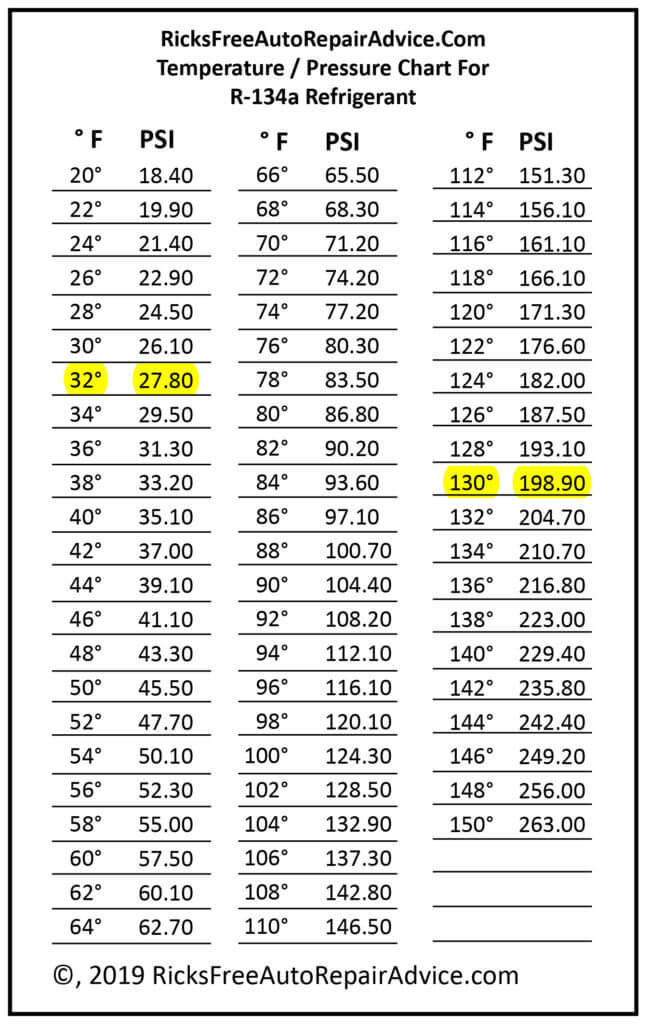
WARNING: Ambient temp is the temperature at the vehicle under the hood, Not THE WEATHER SERVICE.
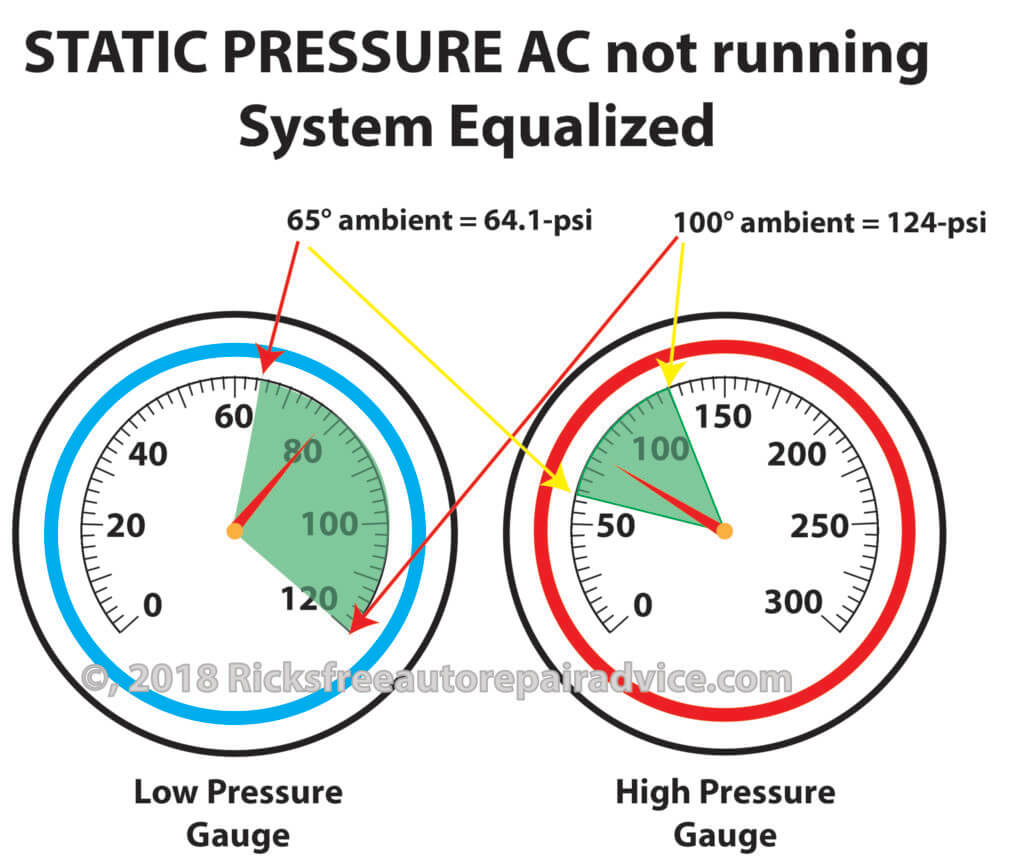
What static pressures really means
A low static pressure reading means the organisation is low on refrigerant
Static pressure but tells y'all two things
If the low and loftier side gauges read the same pressures and the readings correlate to the pressures/temperatures shown on the chart to a higher place, they but tell you two things:
- The system isn't completely empty
- The system pressure is high enough to enable compressor clutch engagement.
If the static pressure is lower than 27-psi. with an ambient temperature to a higher place 33°) the AC system volition not engage the compressor and you will not get any cooling.
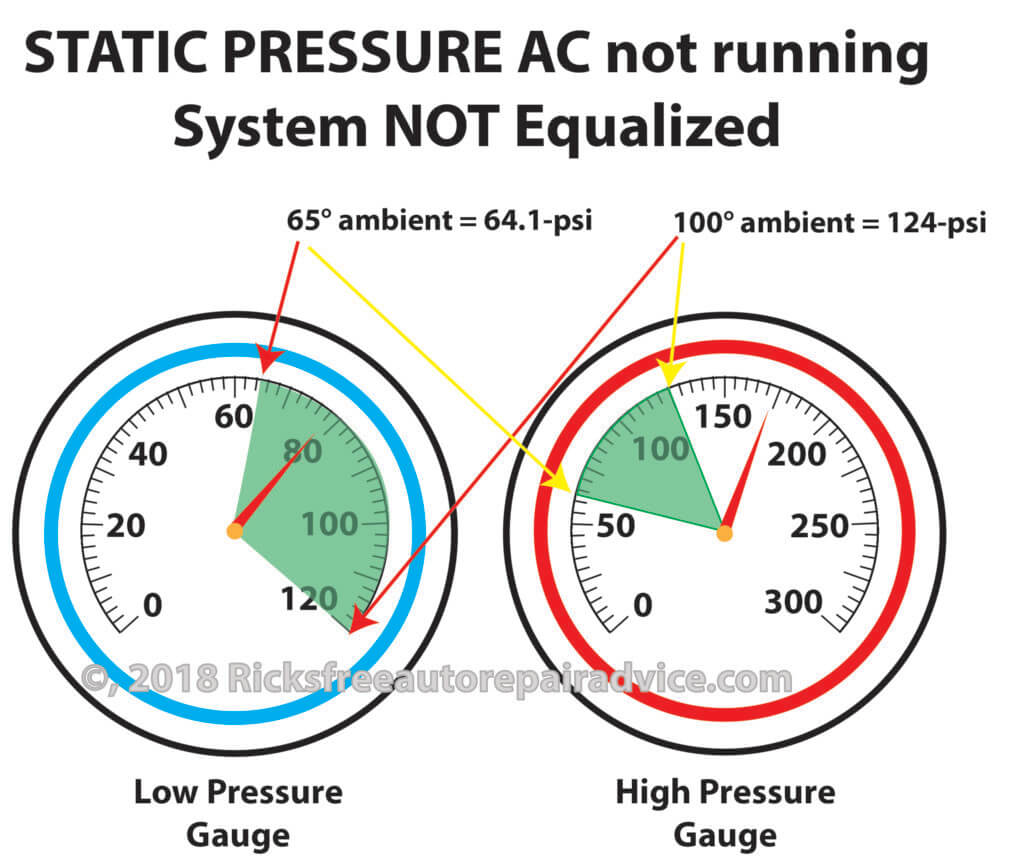
If the gauges aren't the same during a static pressure test
If the gauges don't read the same during a static pressure level exam, information technology ways:
1) You haven't waited long plenty for the pressures to equalize, or
two) The orifice tube, expansion valve, compressor reed valves or stuck or there's a severe restriction somewhere in the system that's preventing the force per unit area from equalizing. In that case, you must set that problem outset.
Troubleshooting incorrect static pressures
If your static pressure readings don't match the temp/pressure chart and are likewise high (most common) these are the likely causes:
-
- Air in the organization from leaks
- Overcharged
- Refrigerant is contaminated
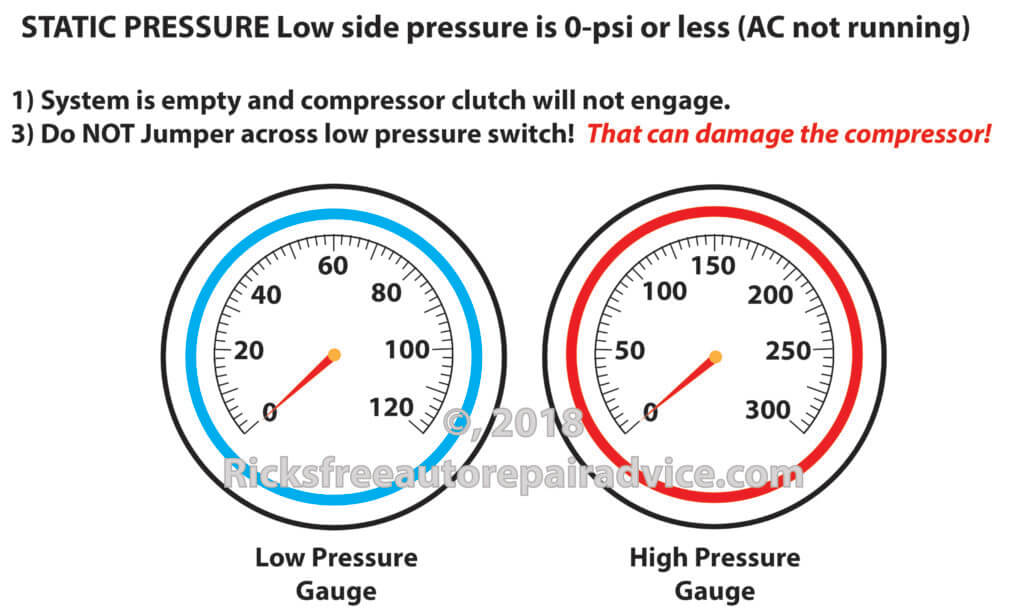
What 0 static pressure means
The entire AC organization is empty due to a major leak. Find the leak and fix earlier refilling.
What are normal Air conditioning gauge pressures when the system is running?
Generally speaking, you want around 27-psi on the low side and 200 on the high side. Why 27-psi? Because, on an R-134a Air-conditioning system, 27-psi. on your estimate means the refrigerant volition produce nigh 32°F at the evaporator (as long equally the orifice tube/expansion valve is operating properly and at that place's no air in the arrangement that'due south artificially inflating the pressure to 27-psi). That'south just effectually the freezing point of water.
On the high side, R-134a pressures usually run two.two to 2.5 times the ambient temperature entering the condenser. Then, if the ambient temperature is 80°F, you lot'll run into loftier side pressures running between 176-psi and 200-psi. on an R-134a system. At 200-psi. the refrigerant entering the condenser will exist effectually 130°F.
For more information on normal AC pressures, encounter the charts below.
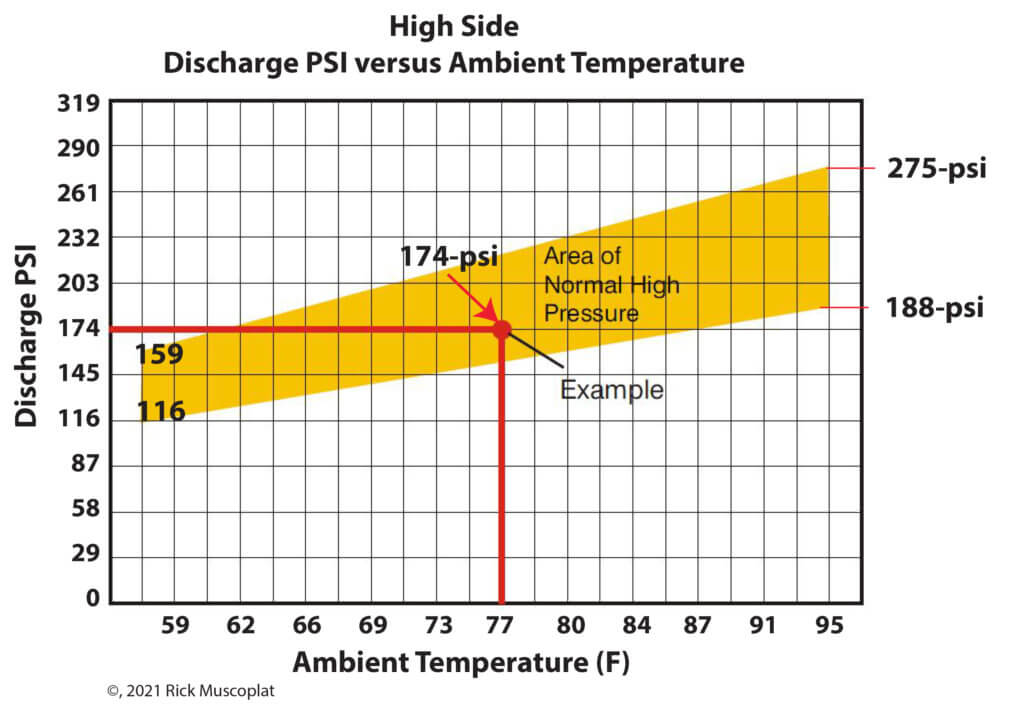
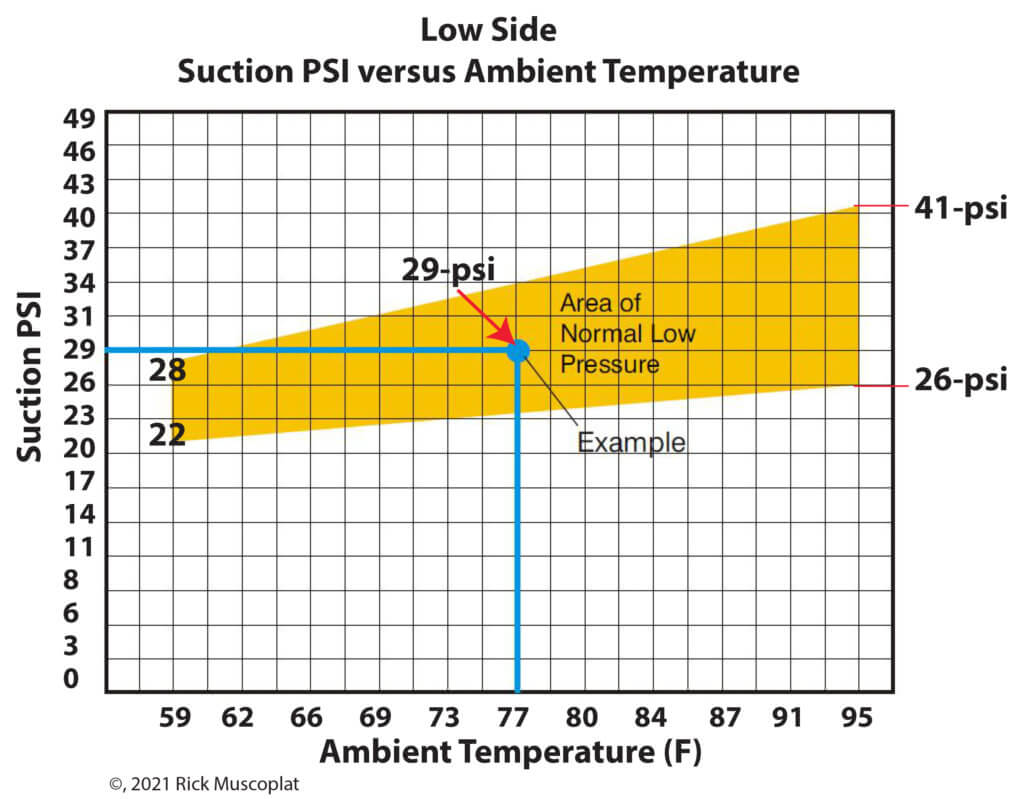
Normal high and low AC ambience temperature pressure level listing
Ambient Temperature in °F Low side Pressure Gauge reading and High side Pressure Gauge reading
65°F Ambient temperature: Low side pressure 25-35 psi High side pressure 135-155 psi
70°F Ambient temperature: Depression side pressure 35-40 psi High side pressure 145-160 psi
75°F Ambient temperature: Low side force per unit area 35-45 psi High side force per unit area 150-170 psi
80°F Ambience temperature: Low side pressure forty-50 psi High side pressure 175-210 psi
85°F Ambience temperature: Low side pressure 45-55 psi High side force per unit area 225-250 psi
xc°F Ambience temperature: Low side force per unit area 45-55 psi High side pressure 250-270 psi
95°F Ambient temperature: Low side pressure 50.55 psi Loftier side pressure 275.300 psi
100°F Depression side force per unit area 50-55 psi Loftier side pressure 315-325 psi
105°F Ambience temperature: Low side pressure level 50-55 psi High side pressure 330-335 psi
110°F Ambient temperature: Low side pressure l.55 psi High side pressure 340.345 psi

NOTE: High humidity and airflow velocity beyond the evaporator and condenser take a direct issue on pressure readings.
How to test AC pressures with a manifold gauge
ane, Set the AC controls to MAX and RECIRCULATE
2. Blower set to HIGH speed
3. Close the doors. Windows tin be open up.
4. Once you attach your gauges and beginning your engine, keep RPMs steady at around 1,200 to i,500 RPM.
Go on in mind that Air-conditioning pressures and middle duct temperatures are directly related to ambience temps and relative humidity.
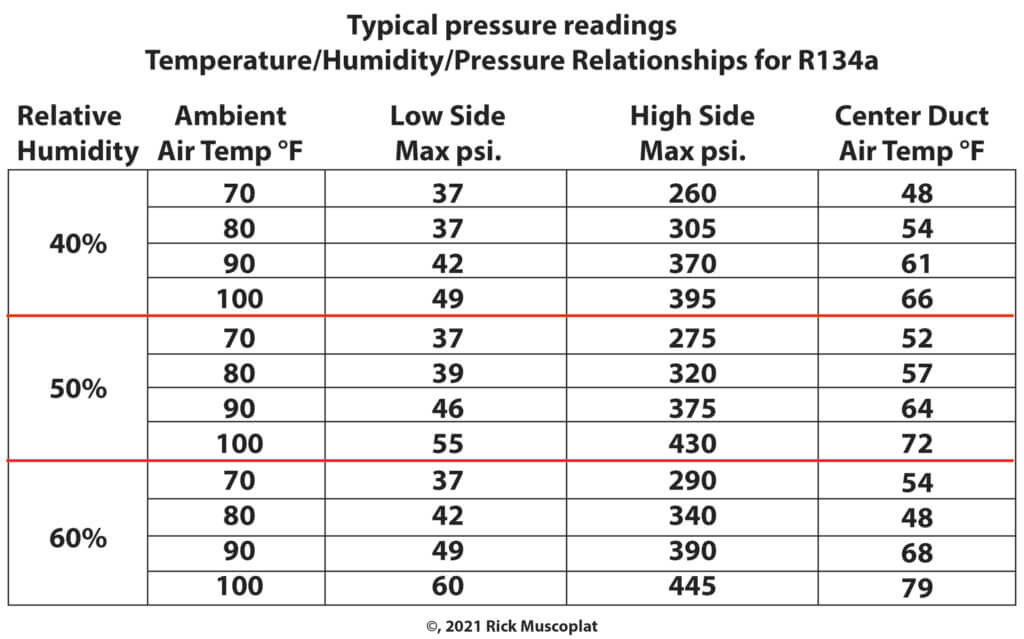
If your readings are outside the typical pressure level/temperature range, see below.
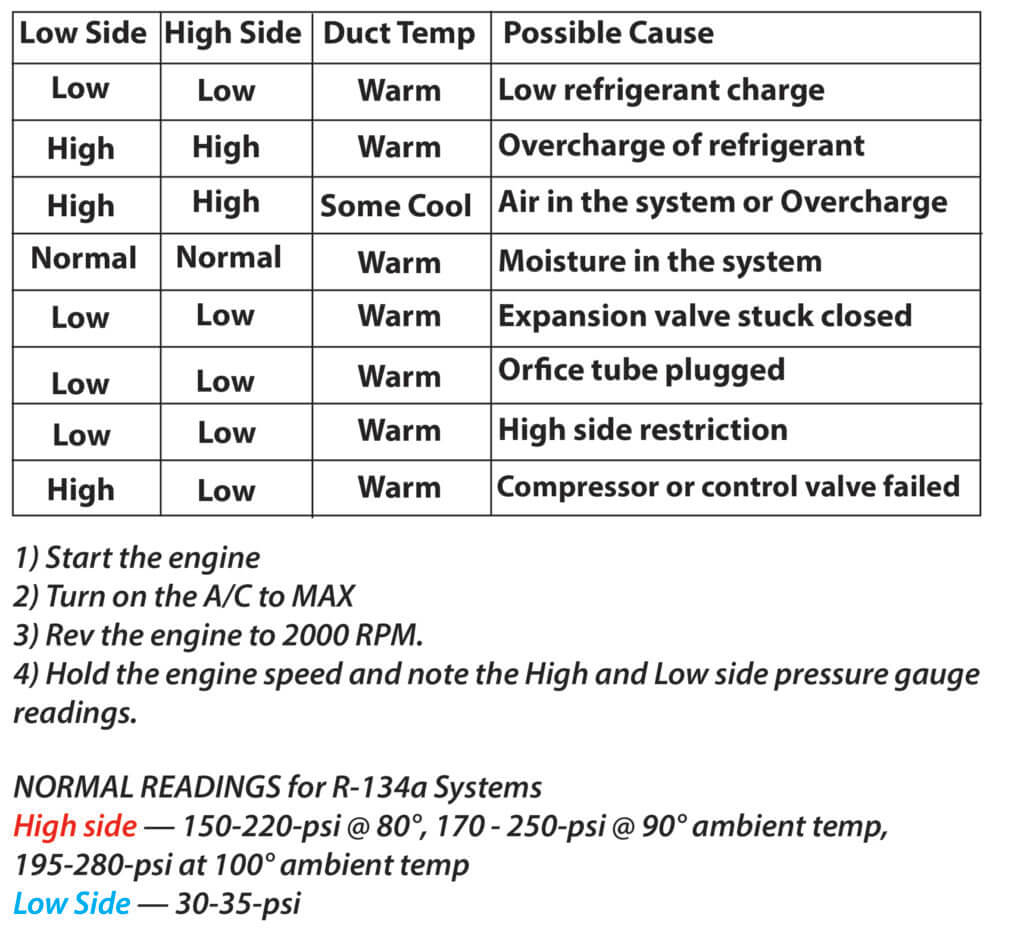
What the Air-conditioning gauge pressures mean
Kickoff, to properly diagnose Ac pressures when the Ac is running you MUST know what blazon of Air-conditioning system you're working on . Is it a cycling clutch orifice tube system or an expansion valves arrangement? If you don't know the difference, you tin't diagnose past pressures.
Come across this mail service to acquire what type of AC system is in your vehicle.
Low and High Ac pressures are nigh the same
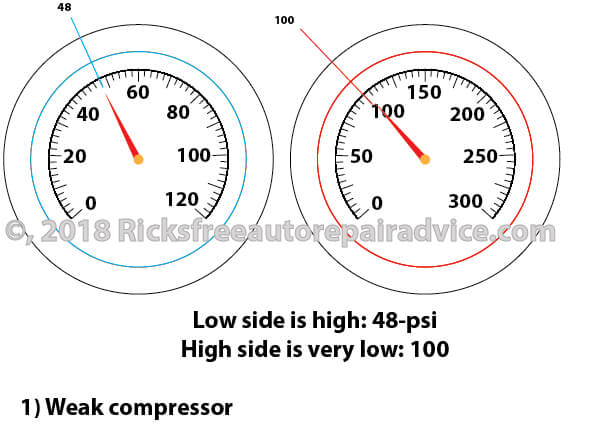
If the compressor is running (center portion of the pulley is turning), the compressor is spinning but not pumping. That's an indication of a bad compressor. If the center pulley isn't turning, run across this mail service for diagnostics.
Symptoms of a bad Air-conditioning compressor
• Low and high side pressures are nigh the same (like 80-psi low side and 80-psi loftier side) AND you have to increase RPM quite a bit to become pressures into the normal range AND y'all notice the air simply gets cold when you're driving AND yous've ruled out a low refrigerant charge or bad orifice tube/expansion valve.
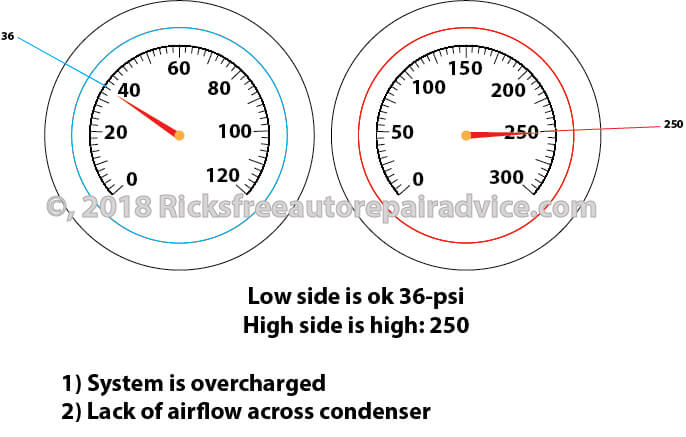
Low and High Air-conditioning gauge pressures are high with no fluctuation
The system is overcharged, there's a lack of airflow beyond the condenser (clogged fins, radiator/condenser fans non working or not working at the proper speed), or you have air and moisture in the system.
What to do if AC pressures are loftier:
1. Bank check the front of the AC condenser (it's in front of the radiator) to brand certain the fins aren't chock-full.
2. Check to make sure the radiator fans are working at the proper speeds.
3. Evacuate the system and recharge with the correct refrigerant charge and examination again.
Low and Loftier AC pressures are lower than recommended on an orifice tube organization
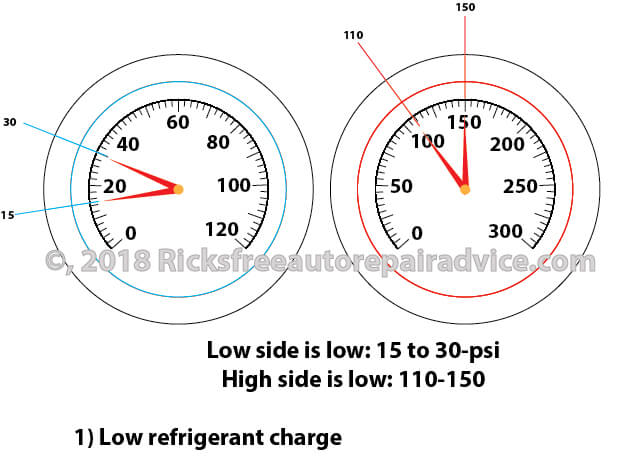
Symptom: Depression cooling
Pressure readings: Low side is depression. High side normal to slightly depression
Causes: Low on refrigerant charge
In this case, the evaporator is starved for refrigerant. In a fixed orifice tube organisation, you want the evaporator almost completely total of refrigerant. When properly charged, a total evaporator will spill some boiling refrigerant into the accumulator where it volition continue to vaporize before entering the compressor.
However, if the system is low on charge, the evaporator is only partially filled with refrigerant, so one-half of information technology will be cold and the other half hot. This often causes evaporator icing, where ice builds up on the evaporator. The ice blocks airflow and the low pressure triggers the depression-pressure level switch.
Depression refrigerant charge causes superheat
Keep in heed that AC works when the refrigerant removes just enough heat from the air to cause the refrigerant to change from a liquid to a vapor. Yet, in a partially filled evaporator, the vapor then absorbs estrus. This is called superheat and in an orifice tube organization, the superheated refrigerant is what causes evaporator icing
In other words, the low refrigerant accuse causes the refrigerant is in the organization to sit too long in the evaporator. So the refrigerant picks up too much heat. Showtime, it picks up enough heat to cause the refrigerant to change state from liquid to gas. THEN, the gas absorbs even more heat from the evaporator airflow, causing evaporator temperature to autumn below the freezing betoken of water. Whatsoever ambient wet immediately freezes on the evaporator fins.
Test for evaporator freeze-up
To exam for evaporator freezing, plow off the engine and exit the vehicle for a while. When you return, examine the pool size under the vehicle. A large pool is an indication of evaporator water ice that has melted and tuckered onto the footing.
OR, go on driving the vehicle with the blower on HIGH while monitoring airflow from the vents. Once the evaporator ices over, you should notice a dramatic reduction in airflow from the vents. The compressor will close off once the low pressure level triggers the low-pressure switch. The blower will melt the ice. Low side pressure will increase to the indicate where the low-pressure switch activates the compressor. So you'll get common cold air over again—until the evaporator ices up once again. The pattern will repeat over and over.
Notation: Low airflow beyond the evaporator, caused by a plugged motel air filter, can mimic the symptoms of a low refrigerant accuse. Also, a faulty evaporator temp sensor can prevent the system from shutting downwardly one time the evaporator has iced over.
Restricted or plugged orifice tube can also cause low pressure on an orifice tube arrangement
Brake in the depression side of the organisation. For example, a restricted orifice tube will crusade the compressor to suck, but the restriction/clog in the orifice tube prevents the total menses of refrigerant, causing evaporator starvation. Low side force per unit area drops below low-force per unit area switch threshold, which shuts off the compressor.
What causes orifice tube restriction?
Debris is clogging the orifice tube screen
• Metallic wear particles from the compressor clog the orifice tube screen.
• Safe hoses deteriorate over fourth dimension and safety particles clog the orifice tube screen.
• Wet in the system reacts with the refrigerant and oil to form acids and sludge that clog orifice tube screen
• Wet in the organisation that freezes at the orifice tube and restricts refrigerant menstruum through the orifice. An Air conditioning system leak allows moisture into the system. The wet travels with the refrigerant. Since the temperature is near the freezing point of h2o correct at the orifice tube, the moisture freezes, cutting off the flow of refrigerant into the evaporator.
To test for moisture: Turn Air-conditioning off for ten-fifteen mins, then dorsum on. If the gauge reading goes dorsum to a very depression suction-side reading, the orifice tube or expansion valve screen is likely frozen. If the gauge reading is normal when first turned on and stays normal for a few minutes, y'all get cold air and And so low side goes low, that's a sign of moisture in the system. Or, if y'all can access the orifice tube, apply estrus to the orifice tube every bit you watch system pressures. if the system pressure returns to normal once you've practical rut to the orifice tube, the cause may exist wet in the system.
The orifice tube is the incorrect size
• the orifice tube is too large
• the orifice tube has been replaced and the O-band isn't seated properly. In other words, the system tin can't build pressure level.
Low side Ac pressure is VERY low and loftier side pressure is low: restriction

Low and High AC pressures are lower than recommended in an expansion valve system where the valve is located on the evaporator outlet
The expansion valve is stuck open and so the system can't build pressure or the thermal bulb that measures evaporator temp isn't working properly and is causing the expansion valve to remain open.
Low and high side Air conditioning pressures are normal but the air isn't common cold
This may be a situation where the AC is working fine merely the "heat is on," diminishing the effects of the Air-conditioning. This tin can be caused by a stuck air temperature door, faulty air temp/blend door actuator or, in older systems, a stuck open heater control valve that'southward running hot engine coolant into the heater cadre even though the oestrus is set to cold.
What to check:
Check heater command valve
Determine if the vehicle has a heater control valve. The valve is usually located under the hood and is opened and closed by a vacuum motor or cable. Look for heater hoses and either a cable or vacuum hoses running to a valve. Utilize a paw pump vacuum to operate the valve or movement the cable by hand to shut it off. Then checking cooling.
Check air temperature or blend door and actuator
If the cabin air temp is controlled by an air temp/blend door, check actuator performance to see if it moves every bit yous change the temperature setting. In some cases, the ready can be as simple as replacing an actuator. If the actuator moves but the air door doesn't effort moving the door by manus. Many times the door can get stuck or break off from its hinges.
Check the cabin air filter
Yeah, it'southward but like a furnace filter. If it'southward chock-full, information technology tin can restrict airflow. That, in plow, causes the evaporator to freeze up which shuts off the Ac. Don't skip this part. Many DIYers replace AC parts only to discover a clogged motel air filter after spending hundreds on parts.
Bank check for a muddied evaporator roll
Leaves and grit can clog the fins of an evaporator ringlet, reducing its power to remove heat from your car. To access the evaporator coil, remove the blower motor resistor, and have a peek within. To clean the evaporator coil, use a foaming chemical cleaner.
For more troubleshooting tips using gauges, meet this mail
©, 2020 Rick Muscoplat
Posted on by Rick MuscoplatSource: https://ricksfreeautorepairadvice.com/ac-pressure-gauge-readings/

Post a Comment for "Should I Read Ac Pressure in My Car When the Compressor Cycles on or Off"